
What Is A Performance? First Impressions

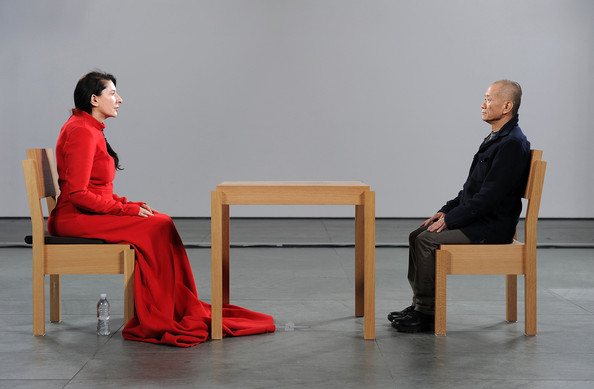
Before starting this module I only ever thought of performances as people reciting lines on stage. However, after a few seminars I am beginning to understand that a performance can be anything. As Marvin Carlson states ‘’the recognition that our lives are structured according to repeated and socially sanctioned modes of behaviour raises the possibility that all human activity could potentially be considered as performance, or at least all activity carried out with a consciousness of itself’’ (2004, pg.4). A performance is whatever the artist decides is a performance. Some of the pieces we have looked at so far, including Marina Abramovic’s The Artist is Present, have had a big impact on me. At first, when I just read about this piece, I thought who would actually want to go and see something like that. However, once I had experienced it I felt completely different. We sat opposite one another for one hour and five minutes, in a similar style of The Artist is Present, and experienced a fragment of what this performance was. It left a huge impression on me as it was an extremely tense, yet thrilling, experience which helped me to understand what Contemporary Experimental Performance is.
Work Cited

Carlson, Marvin (2004). Performance: A Critical Introduction. London: Routledge.

Posted in Jessica Smith, Research | Comments Off on What Is A Performance? First Impressions

In The Begining

What is Contemporary Experimental Performance?

How do you create a piece of Contemporary Experimental Performance?

What are you limitations, if any?

What is performance?

These are all questions that I had as I went to my first contemporary experimental performance (CEP) seminar. Fortunately I realised during this seminar that CEP can be anything you want it to be and you can create a CEP in any way you want. Limitations… What limitations? This module explores a way to take risks in performance and bend the rules of performance space, time and action, among many more things. “Performances mark identities, bend time,  reshape  and  adorn the body, and tell stories” (Schechner, 2002, p.28) highlighting exactly what CEP is.

With all of these options, I looked at ideas that have sprung to mind regarding performance and tried to pinpoint where I personally wanted to take it. I had that many ideas that I struggled to focus on any one thing.

Next I considered what questions I wanted to focus on during this module and the main one that stuck was:

How to make the audience feel uncomfortable?

This has always been an aspect of performance I have wanted to explore and with this in mind, I focused on reading an interview with Marina Abramovic, a performance artist who manages to do this exact thing. I have looked into her performance The Artist is Present  and we also looked and experienced a similar performance in our second seminar.

We were instructed to sit across from a member of the group and just look at them. This went on for just over an hour and I found out a few different things from this experience. The first being that I was uncomfortable having someone looking at my every move and sound. The second being that the silence in the room itself was deafening and every person was able to hear the tiniest of movement. I personally felt very uncomfortable to begin with however, I began to settle into a rhythm quite quickly. This experiment made me even more adamant to create a performance that had this aspect of being uncomfortable for the audience involved.

Work Cited

Schechner, R. (2002) Performance Studies: an introduction, London: Routeledge

Posted in Demi Morrison, Research | Comments Off on In The Begining